
How Expensive Is Your BIas?
We all have them — but we might not all know what our biases are, or what they’re costing us. Knowing ourselves isn't always as easy as we think. Understanding our strengths and weaknesses can prove invaluable in all facets of life, and our finances are no exception. Once we know our biases, we can begin to make better, more objective decisions with our money.
When it comes to investing, our decisions are rarely made in a vacuum. They’re influenced by the news we consume, the conversations we have, the emotions we feel, and even the memories we carry. While logic and analysis may guide some of our moves, biases — unconscious patterns of thinking — often steer us in subtle but powerful ways.
These biases can lead to overconfidence, panic selling, missed opportunities, or taking on more risk than we realize. In a world where market volatility is constant and uncertainty is a given, our ability to recognize and correct for bias could be one of the most valuable skills an investor can develop.
Let’s explore some of the most common investment biases, how they show up in our financial behavior, and what we can do to avoid falling into their traps.
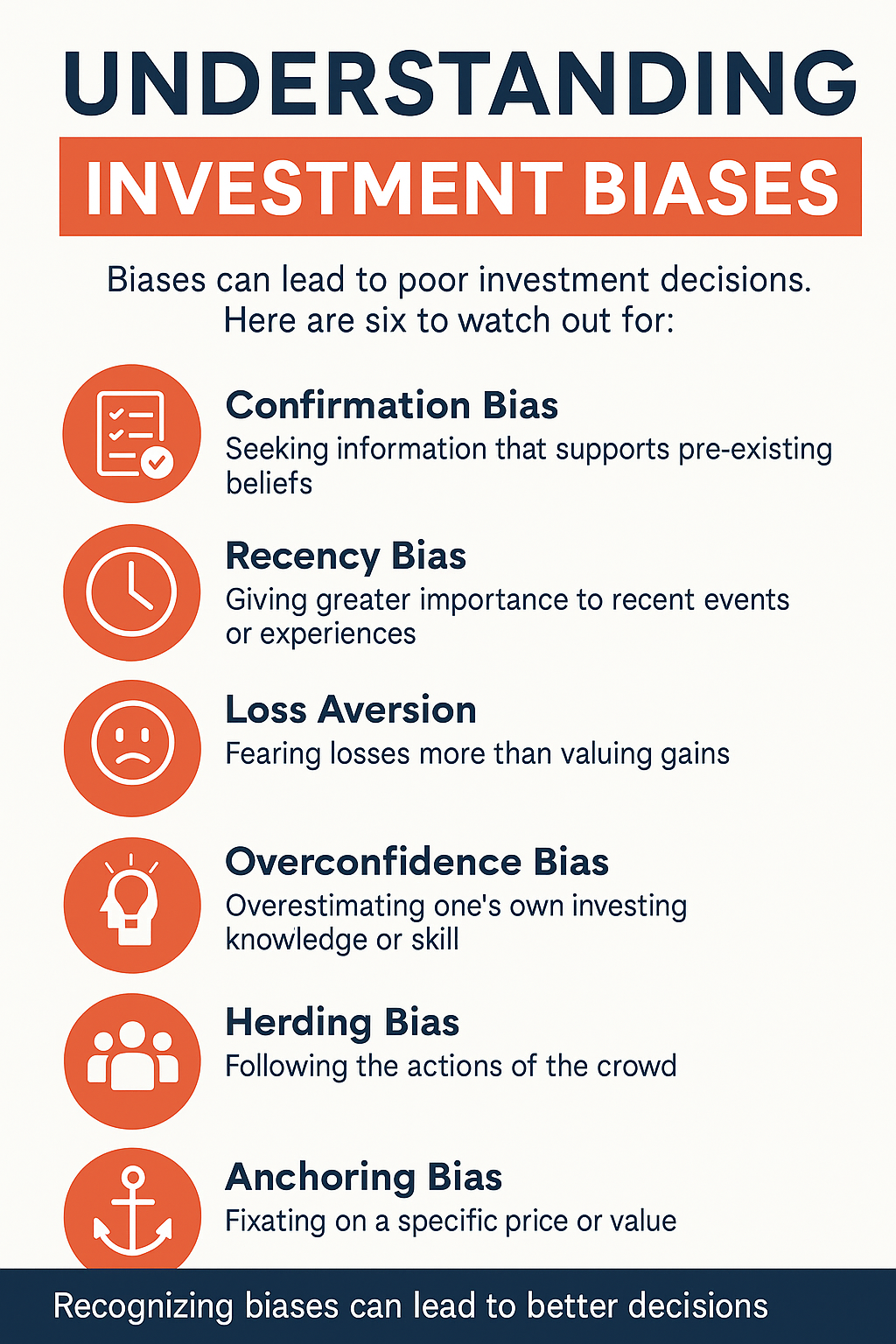
1. Confirmation Bias: Seeking What We Want to Believe
Confirmation bias is our tendency to seek out information that supports our existing beliefs — and to ignore or dismiss anything that challenges them.
For investors, this might look like:
Only reading market news that supports your bullish outlook
Disregarding credible analysis that contradicts your current holdings
Talking only to people who share your investing philosophy
This bias can lead to a false sense of confidence and can keep us from adjusting when conditions change. If you bought a tech stock you loved five years ago, confirmation bias might make you blind to new threats in the industry or the company’s declining fundamentals.
How to counter it: Actively seek out opposing views. Ask, “What would someone who disagrees with me say?” Make sure your investment decisions are based on evidence, not just opinions that feel good to hear.
2. Recency Bias: The Past Month Is Not a Crystal Ball
Recency bias is the tendency to give undue weight to recent events while ignoring longer-term trends and data. It’s why people often assume that what just happened will keep happening.
For example:
A market drop makes you think a crash is inevitable
A hot stock’s recent surge convinces you to buy at the top
After years of strong returns, you assume a portfolio is “safe”
Recency bias can make us chase performance or abandon long-term strategies when short-term results disappoint. But as any seasoned investor knows, the market is anything but predictable in the short run.
How to counter it: Take a step back. Look at data over longer time horizons. Don’t assume that last quarter’s performance is a trend — it might just be noise.
3. Loss Aversion: The Pain of Losing Hurts More Than the Joy of Gaining
Studies show that we feel the pain of a loss twice as strongly as we feel the pleasure of a gain. This is called loss aversion, and it can have a dramatic effect on our behavior.
This bias often causes investors to:
Hold onto losing investments too long, hoping to “get back to even”
Avoid necessary risk, even when it could support their goals
Panic sell during downturns just to avoid more perceived pain
Loss aversion can keep us from cutting losses when needed or from taking the right amount of risk to meet our long-term objectives.
How to counter it: Reframe the conversation. Instead of focusing solely on avoiding losses, focus on what’s needed to reach your goals. A financial plan helps shift the mindset from short-term pain to long-term purpose.
4. Overconfidence Bias: Thinking We Know More Than We Do
Overconfidence bias is exactly what it sounds like: the tendency to believe we’re better at something than we really are — in this case, investing.
Investors plagued by overconfidence might:
Trade excessively, believing they can time the market
Take concentrated positions in certain sectors or companies
Dismiss professional advice or risk-management strategies
While confidence can be a good thing, overconfidence can lead to excessive risk-taking and under-diversification. It can also cause investors to underestimate the role of luck and randomness in market outcomes.
How to counter it: Track your decisions and results over time. Use performance data to inform your self-assessment, and don’t be afraid to lean on experts who can offer objective insight.
5. Herding Bias: Following the Crowd
Ever feel tempted to jump into a hot investment just because “everyone else is doing it”? That’s herding bias, and it’s rooted in our human need for social belonging and fear of missing out (FOMO).
This bias was front and center during episodes like the meme stock craze, crypto surges, and tech bubbles. It can lead to speculative behavior, buying high, and selling low — especially when market manias reverse.
How to counter it: Ask yourself: Would I make this investment if no one else was talking about it? Does it fit with my overall strategy? Popular doesn’t always mean prudent.
6. Anchoring Bias: Stuck on the Wrong Number
Anchoring bias happens when we latch onto a specific reference point — even if it’s arbitrary — and use it to make decisions.
You might be anchored if:
You refuse to sell a stock because it’s “down from where I bought it”
You think a stock is “cheap” just because it’s fallen 30%
You base your retirement savings on a number you saw in an article years ago
Anchoring can lead to unrealistic expectations or poor decision-making if the reference point is outdated or irrelevant.
How to counter it: Use current, comprehensive data. And always evaluate investments and goals based on their present context — not just past numbers.
Why This Matters
Biases don’t just affect portfolio performance — they affect peace of mind, confidence, and long-term financial security. When we make decisions based on fear, ego, or shortcuts, we risk undermining the very goals we’re working toward.
But there’s good news: awareness is the first step toward control. Recognizing these biases allows us to pause, reflect, and ask better questions. It helps us become more intentional investors who act with clarity rather than react out of habit.
Tips for Becoming a More Objective Investor
Here are a few practical ways to minimize bias in your financial life:
Have a plan – A clear, values-based financial plan gives you an anchor rooted in purpose, not emotion.
Check yourself – Ask, “What bias might be influencing this decision?”
Work with a professional – A trusted advisor can provide perspective you might not have alone.
Pause before reacting – Most poor financial decisions come from rushing.
Review regularly – Evaluate your portfolio and decisions with fresh eyes, not just past assumptions.
Final Thoughts
We can’t eliminate our biases — they’re hardwired into us. But we can acknowledge them, account for them, and learn to think more clearly about our financial choices.
The next time you feel the urge to buy, sell, or shift direction in your investments, take a moment to ask: Am I being objective? Or is a hidden bias calling the shots?
A little self-awareness today could make a big difference for your financial future tomorrow.
